

Blog
Is Water Dispenser Good for Health?

Reviewed by the Tahoe Springs Water Team
Last Updated: 08/06/2026
Reading Time: 9–10 Minutes
If you’re asking yourself, “Are water dispensers safe or good for health?” you’re not alone. A lot of people want to know if drinking from a dispenser is better, easier, and, most importantly, safe for their health.
Yes, water dispensers are safe to drink from. The water itself is not the problem. The real risk comes from bacteria that build up inside the machine when it is not cleaned often enough. Clean it on a normal schedule, change the filter on time, and a water dispenser is a safe, easy, and healthy way to drink more water every day.
Keep reading to see exactly how safe dispensers really are, what the research says about bacteria, and the simple steps that keep your water clean and safe to drink.
Is Dispenser Water Safe for Drinking?
Yes, water dispensers are safe, but only if you take care of them. Just like anything you use for food or drinks, you have to keep it clean. Think about your coffee mug. If you never washed it, would you still drink from it?
A water dispenser can get dirty if you leave it alone for too long. Bacteria love damp, dark places. Some studies even showed that dispensers not cleaned often can grow germs that are not good for your health. But don’t worry! This does not mean the water is unsafe. It means the machine needs care.
Here’s a simple schedule to keep your water dispenser water safe:
- Clean the outside and taps every week to keep germs away.
- Deep clean the inside every 1 to 2 months to prevent buildup.
- Change the water filters every 6 months or as the manufacturer recommends.
- Check for leaks or mineral buildup every month to catch problems early.
- Sanitize the bottle neck and spout area every time you put on a new bottle.
Follow that schedule, and a water dispenser is just as safe as any other way of drinking water, and often safer than water that sits out in an open cup or an old plastic bottle.
Special Offer
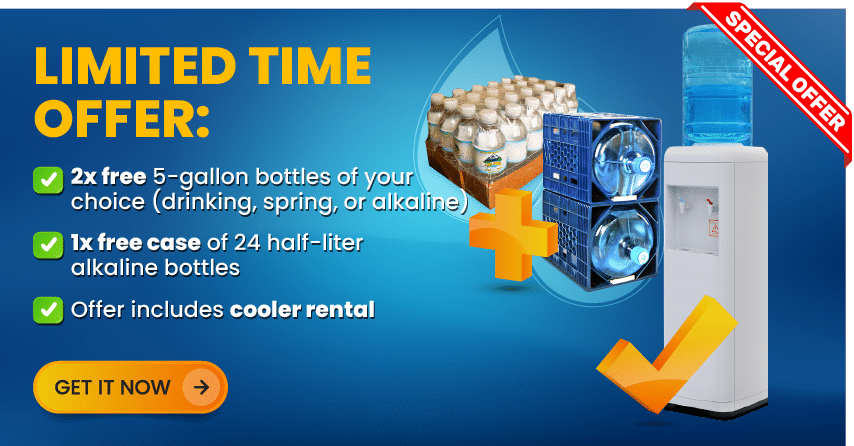
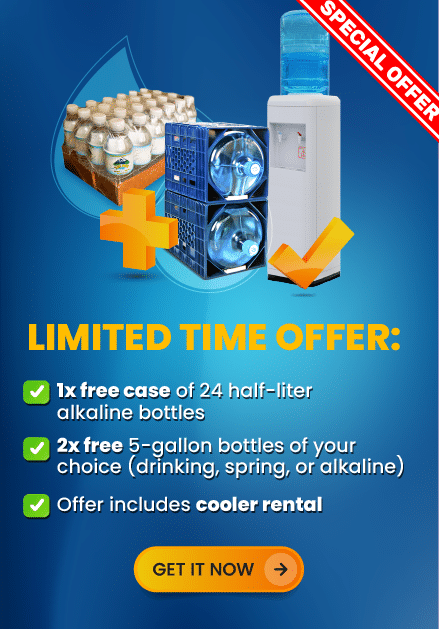
Click on the link below or call us to enjoy the special offer to get “2 bottles of 5 gallon water” free delivered to you with no obligations, no long term contract, just high quality, and delicious drinking, spring, or alkaline water.
What Does the Research Say About Bacteria in Water Dispensers?
Studies on water dispensers have found bacteria levels inside some machines higher than the safety limit set by the Environmental Protection Agency, and higher than the tap water that fills them. Some machines have also tested positive for germs such as Pseudomonas and coliform bacteria.
The cause is usually biofilm, a thin layer of bacteria that sticks inside pipes, taps, and tanks and keeps releasing germs even after the outside looks clean. A quick wipe down does not remove it. Only a real deep clean on a schedule does.
Biofilm needs time and neglect to build up, so it is easy to prevent. To avoid these water dispenser health risks, you need to clean your dispenser on the schedule we mentioned above, with filters changed on time, and do not give bacteria the chance to take hold.
Bottled vs Bottleless Water Dispensers, Which is Safer?
| Bottled Dispenser | Bottleless (Point of Use) Dispenser | |
| How it works | A large jug sits on top or in a cabinet, and gravity or a pump moves water to the tap | Connects straight to your home’s water line and filters water as it flows through |
| What to watch | The bottle neck and spout, where hands and air touch the water most | The internal filter and tubing, since water sits inside longer between uses |
| Upkeep needed | Fresh, sealed bottles and regular cleaning | Regular cleaning and scheduled filter changes |
Neither type is automatically safer. What matters is upkeep. A bottled dispenser with fresh bottles and regular cleaning is just as safe as a well-maintained bottleless system. If you want water delivered so you never have to think about the source, a bottled water delivery service in Las Vegas makes that simple.
Water Dispenser vs Tap Water, Which is Safer?
| Water Dispenser | Tap Water | |
| Starting point | Filtered water, often delivered or drawn fresh | Treated and tested by your local water provider |
| Main risk | Bacteria buildup if not cleaned on schedule | Lead, rust, or minerals picked up from old home pipes |
| Taste | Usually fresher, since filtering removes extra minerals | Varies by home, depends on pipe age |
Tap water starts out safe in almost every case, since it is treated before it reaches your home. The real risk is what happens after that, inside your home’s own pipes. A clean, well-filtered dispenser skips that risk and usually tastes better too, which is why it comes out ahead in most homes, especially older ones.
Is It Safe to Drink Hot Water from a Water Dispenser?
Yes, drinking hot water from a good water dispenser is totally fine. Most dispensers heat water to 85 to 95 degrees Celsius. That kills common germs like E. coli, though it falls just short of a full boil. Regular cleaning still matters, since that is what keeps bacteria out in the first place.
The material matters too. Older plastic tanks can release small amounts of chemicals at high heat. Stainless steel tanks and BPA-free plastics avoid this, so check for that when buying a new dispenser.
Hot water from a dispenser can burn skin instantly. Keep young children away from the hot tap, and choose a dispenser with a child lock or a guarded spout if kids are in the house.
Signs Your Water Dispenser Needs Cleaning Right Now
Do not wait for the next date on your cleaning schedule if you notice any of these signs.
- The water tastes odd, flat, or slightly off.
- You notice a smell coming from the tap or the tank.
- The water looks cloudy or has small particles floating in it.
- Water flows out slower than usual.
- There is a slimy film anywhere near the spout or bottle neck.
Is Water Dispenser Water Safe for Babies, Kids, or People with Weak Immune Systems?
Water from a clean, well-maintained dispenser is safe for most kids and adults. Two groups need extra care.
- Parents mixing baby formula should ask their pediatrician about water temperature and whether to boil it first.
- People with weak immune systems, such as those in cancer treatment, should ask their doctor about extra precautions.
Everyone else can treat dispenser water like any other clean drinking water, as long as the dispenser stays on its cleaning schedule.
Healthy Water Dispensers in Las Vegas
Las Vegas water is naturally hard, which means it carries more minerals than water in many other cities. That mineral content can build up inside a dispenser faster than it would somewhere with softer water, so homes here benefit from sticking closely to the cleaning schedule above.
Tahoe Springs Water offers dispensers built for exactly this, including hot and cold coolers, cold only coolers, and ceramic tank models with a wooden stand. Our team helps with maintenance and filter changes so you are not left to figure it out alone.
We are an A+ rated, BBB accredited company, accredited since June 15, 2012. We accept credit cards and welcome every customer.
Call us at 702-433-4545, or visit us at 3300 Meade Ave, Las Vegas, NV 89102, to set up a dispenser or start water delivery in Las Vegas today.
Let’s Recap
Are water dispensers safe? Absolutely! Water dispensers are safe for drinking, cooking, and everyday use, as long as you clean them on a normal schedule, change the filter on time, and use clean, sealed water bottles if your dispenser uses them. The water is not the risk. Neglect is. A little regular care goes a long way.
FAQs
Is water dispenser safe?
Yes. A water dispenser is safe when cleaned weekly, deep cleaned monthly, and its filter is changed every six months.
How often should I clean my water dispenser?
Wipe the outside weekly, deep clean the inside every one to two months, and check for leaks or buildup monthly.
Can bacteria grow in a water dispenser?
Yes. Bacteria can build up inside the tank and spout as biofilm. Regular cleaning and filter changes stop it.
Is it safe to drink from a water dispenser?
Yes. Clean water dispensers are very safe. Wipe them weekly, deep clean monthly, and change the filter every six months.